November 10, 2024 • By Evonix Team
Origins and Cultural Significance
Hazari is a quintessential South‑Asian card game that weaves together elements of rummy, poker and classic trick‑taking games. Its roots are murky – some claim it evolved from the ancient Persian game of ganjifa, while others see parallels to European games introduced by traders. What is clear is that by the mid‑20th century it had become a staple in Bangladesh and West Bengal, played in tea stalls, on college campuses and during festive gatherings. The name “Hazari” refers to a thousand, alluding to the score players must reach to win. Unlike most trick games, Hazari asks you to partition your hand into several mini‑hands and then play them in sequence. This unique structure feels like juggling four games at once and creates endless strategic possibilities.
How to Play
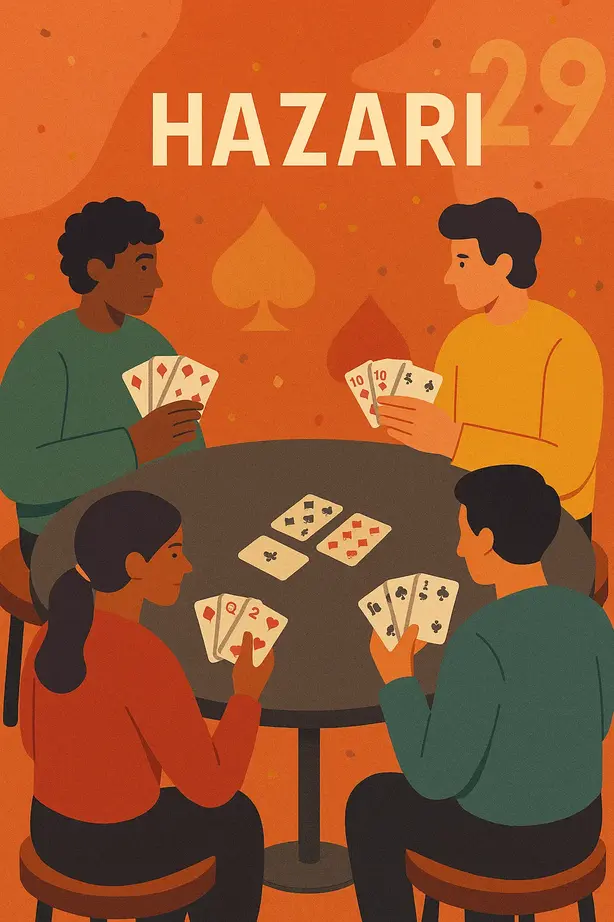
Hazari is designed for four players, usually playing individually rather than in partnerships. A standard 52‑card deck is used, and at the start of each round the dealer deals 13 cards to every player. Here is where Hazari diverges from most card games: before any tricks are played, you must divide your 13 cards into four groups. Three of these groups contain three cards each, and one group contains four cards, of which only three will count towards the combination. The group of four is always considered your lowest hand, encouraging players to balance their strength across the remaining three hands. Once you’ve decided on your partition, you place the groups face down in a stack and declare “up” – signalling that you’re ready to start. Changing your mind after declaring is not allowed, so careful planning is crucial.
Understanding the Combinations
The ranking of hands in Hazari is reminiscent of poker, with some twists. The highest possible combination is a troy – three cards of the same rank, such as three queens. Next is a colour run, sometimes called a straight flush: three consecutive cards of the same suit (e.g., 7♠ 8♠ 9♠). Below that comes a run, three consecutive cards of mixed suits (e.g., 4♣ 5♦ 6♥). A colour (or flush) is any three cards of the same suit that are not consecutive. A pair contains two cards of the same rank plus an unrelated card, and an indi is any other combination. When comparing two identical combinations, the sum of the card values (with face cards and tens worth 10 points and low cards worth five) determines the winner. Memorising this hierarchy will help you decide which cards to group together and when to take risks.
Trick‑Taking and Scoring
Once all players have their hands ready, the player to the dealer’s right leads the first trick with their top group. The next player to the right responds with their own top group, and the best combination wins the trick, collecting all the cards. The winner then leads their next group, and play continues clockwise. Because each group is revealed only when played, you never know exactly what your opponents have arranged, which adds suspense and bluffing opportunities. At the end of a round, players tally the points from the cards they’ve won: Aces, Kings, Queens, Jacks and Tens are worth 10 points; all other cards from 9 down to 2 are worth five points. Scores accumulate over successive rounds until someone reaches or exceeds 1,000 points – that player is crowned the Hazari champion. If two players tie above 1,000, the game continues until a clear winner emerges.
Strategy: Balance and Foresight
What makes Hazari captivating is the tension between balance and aggression. When dividing your hand, you must decide whether to place your strongest cards together to win a sure trick or to spread your strength across multiple groups to secure several small wins. Because the first group you play is your highest, there’s an incentive to put your best combination on top and secure early points. However, if you neglect your middle and bottom groups, you might find yourself unable to compete later in the round. Paying attention to what cards have been played also pays off: if you notice that two queens have already appeared, the chances of facing a troy of queens drop dramatically. Observant players track high cards and adjust their expectations accordingly, reserving certain combinations for when they have the greatest chance of success.
Variations and House Rules
Across South Asia, families and card clubs have developed their own twists on Hazari. Some use jokers as wild cards, allowing them to complete runs or pairs more easily. Others permit six players to participate by forming temporary alliances or by dealing smaller hands. In certain regions, the point target may be lower – 500 or 700 instead of a thousand – to accommodate shorter sessions. Another popular variant scores aces and face cards at 15 points instead of 10, increasing the stakes of each trick. When you sit down to play with a new group, clarify these house rules ahead of time; they can drastically alter strategy. Embracing variations keeps the game fresh and underscores Hazari’s status as a living tradition that evolves with its community.
Beginner Mistakes to Avoid
New players often make two common errors: over‑stacking and under‑planning. Over‑stacking occurs when you place all your powerful cards – like aces and kings – in your top group. This might win the first trick, but it leaves your subsequent groups weak and easy to defeat. Under‑planning happens when you don’t arrange your groups in a logical order, causing confusion when it’s time to play. To avoid these pitfalls, sort your hand by suit and rank before partitioning. Look for natural runs or pairs, and aim to create at least two strong combinations instead of one unbeatable one. Remember that Hazari rewards consistency and foresight more than flashy plays; a series of moderate wins often outpaces a single spectacular one.
Etiquette and Social Play
Hazari is as much about camaraderie as competition. Traditionally, players sit on mats or low stools, sharing snacks and stories between rounds. Table talk – casual comments about the game and gentle teasing – is part of the experience, but overtly revealing your hand is frowned upon. Newcomers are often mentored by experienced players who teach them how to partition cards and anticipate others’ moves. Because there are no partnerships, every player is both ally and adversary, creating a dynamic social atmosphere. In some regions, informal tournaments are held during religious festivals or national holidays, turning Hazari into a community celebration complete with prizes and bragging rights.
Digital Adaptation
In recent years, Hazari has enjoyed a renaissance online. Mobile versions, like our own Hazari Royal, allow you to play against AI opponents or challenge friends across the world. Digital interfaces make partitioning your hand as simple as dragging and dropping cards into different slots, and built‑in tutorials help new players learn the rules without intimidation. Leaderboards and matchmaking introduce a competitive edge, while optional chat channels preserve the social spirit of the game. We’ve prioritised fairness by using certified random number generators for shuffling and by providing equal opportunities for free players and premium users alike. Our goal is to capture the essence of Hazari’s tabletop charm while making it accessible to anyone with a smartphone or tablet.
Why Hazari Matters
For us at Evonix, Hazari exemplifies what makes card games special: simple materials, deep strategy and a sense of shared heritage. Each time you divide your hand, you engage in a mini game of probability and psychology. Each trick you play is a conversation with your opponents, a dance of bluffs and reveals. Playing Hazari trains your memory and planning skills, offering cognitive exercise along with entertainment. It also connects you to a tradition that spans decades and crosses borders. Whether you’re a veteran who grew up playing Hazari on long summer nights or a newcomer discovering it through a mobile app, we invite you to join the community and experience the thrill of reaching that elusive thousand.
